

Artificial intelligence is rapidly moving from tools to agents.
That distinction matters far more than many legal teams currently realize.
Most contracts governing AI systems still assume a simple model: a system receives an input, produces an output, and the parties allocate responsibility for the result. That model worked reasonably well when software executed instructions in predictable ways.
But AI agents behave differently. They choose execution paths. They trigger downstream actions. They operate across systems. They update behavior over time.
In other words, they participate in workflows rather than simply executing commands.
That shift quietly breaks many of the assumptions embedded in traditional contract drafting. Liability clauses, indemnities, and use restrictions were not designed for systems that act with varying degrees of autonomy across interconnected environments.
Over the past year, I have found that many organizations are trying to solve this problem in the wrong order. They begin by drafting liability provisions. They debate indemnification. They negotiate risk allocation.
Only later do they discover that they have not clearly defined what the system actually does, what it can access, or when it operates independently.
That is backwards.
Responsibility cannot be allocated correctly if the operational structure of the system has not been mapped first.
To help address this gap, I have been working on a structural model I call the Autonomy Mapping Framework. It is designed to help lawyers, governance teams, and product leaders analyze AI agents in a way that aligns operational control with legal responsibility. You can view the full framework here.
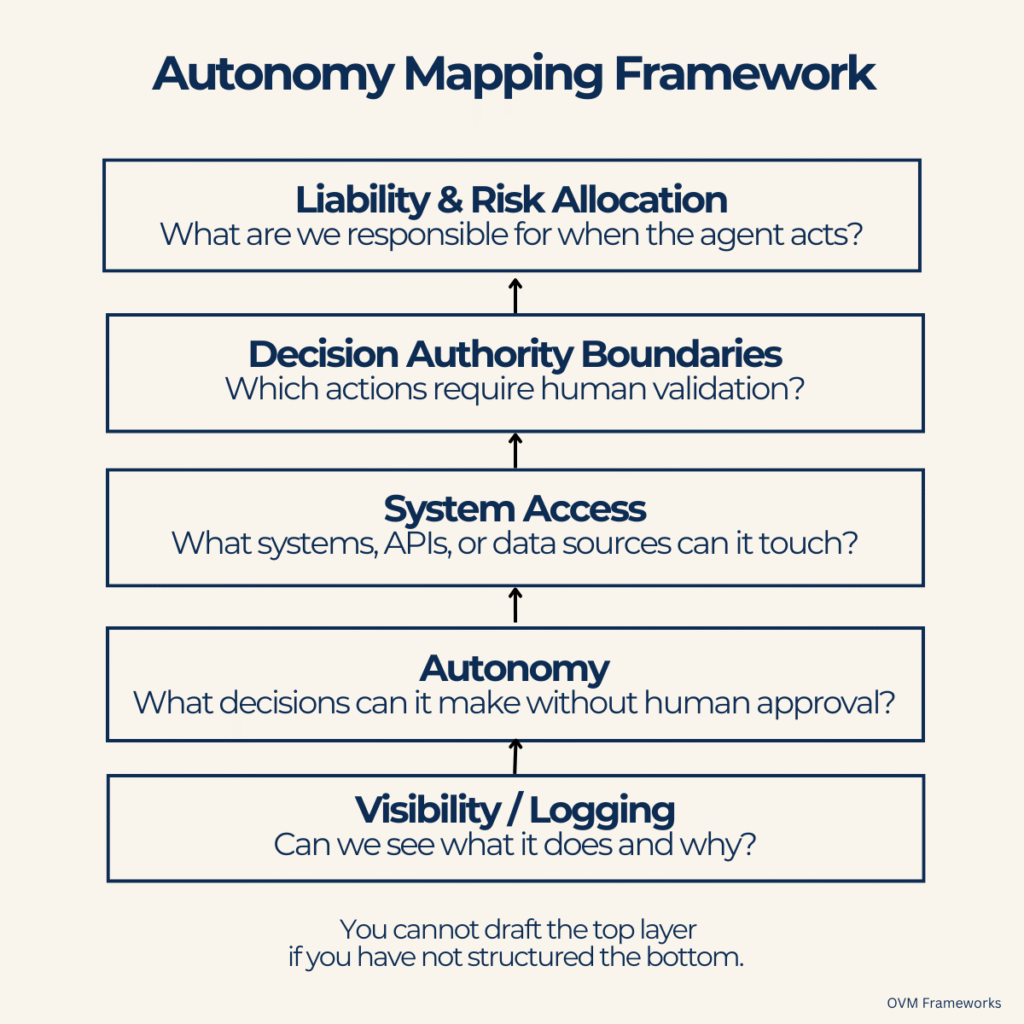
The idea is simple. Before drafting liability provisions for AI agents, organizations should map five structural layers of control.
Each layer reveals where responsibility should logically attach.
Layer One: Visibility Before Responsibility
The first question is deceptively simple.
Can you actually see what the agent is doing?
Many organizations deploy AI systems without defining what activity is logged, how quickly those logs are available, or whether actions are classified by risk tier. In some cases, logs capture outputs but not the triggering inputs. In others, logs are available only after significant delays.
When visibility is weak, oversight becomes symbolic.
For AI agents, logging is not merely a technical feature. It is the foundation of governance. If organizations cannot observe actions clearly and in near real time, meaningful accountability becomes almost impossible.
Before allocating legal responsibility, teams should confirm that the system records key operational events. This includes triggering inputs, execution paths, downstream actions, and risk classifications.
Without defined log content, it is difficult to determine whether an error resulted from the model, the integration environment, the data inputs, or the surrounding workflow.
Visibility establishes the factual foundation on which responsibility will later rest.
Layer Two: Mapping Autonomy
The next step is defining what the agent can decide independently.
Many AI systems operate with varying degrees of autonomy depending on the task. An agent may summarize information with full autonomy while requiring human approval for actions that trigger financial transactions or customer communications.
But that autonomy boundary is often undocumented.
Organizations frequently describe systems as “assistive” or “automated” without specifying which decisions the agent can make without human validation.
This ambiguity creates governance problems. If an agent can independently choose execution paths or trigger downstream workflows, the scope of exposure changes dramatically.
Mapping autonomy means asking questions such as:
What decisions can the agent make without approval?
Does it select execution paths independently?
Can it trigger actions in other systems?
The answers define the surface area of risk.
Autonomy, in practice, determines how much responsibility an organization is implicitly accepting.
Layer Three: Understanding System Access
AI agents rarely operate in isolation. Their power comes from integration.
Agents can query databases, interact with APIs, modify records, or communicate with external systems. A single instruction can create a cascade of activity across multiple environments.
This is why system access must be mapped carefully.
Legal teams should understand exactly which systems the agent can reach, whether those integrations are restricted to approved environments, and whether the agent can modify operational data or send external communications.
These details often determine whether an error remains contained or spreads across systems.
In governance terms, integrations expand the blast radius of autonomy.
Without mapping system access, organizations may underestimate the operational impact of seemingly small decisions made by an agent.
Layer Four: Defining Decision Authority Boundaries
The next question is when humans must intervene.
Some actions should require pre-execution approval. Others can proceed autonomously but trigger alerts. Still others may be suspended automatically if anomalies are detected.
These boundaries must be defined clearly.
Monitoring after execution is rarely sufficient for high-impact actions. For example, approving a marketing email or summarizing research may tolerate retrospective review. Triggering financial transfers or modifying critical records likely should not.
Decision authority boundaries translate technical capabilities into governance rules.
They clarify which actions require human validation, which are allowed to proceed autonomously, and what triggers intervention.
For lawyers drafting governance provisions, this layer is particularly important. It defines the operational checkpoints that support contractual risk allocation.
Layer Five: Aligning Liability With Control
Only after the first four layers are mapped should organizations draft liability provisions.
By that stage, the operational structure of the system is clearer. Visibility reveals what actions can be observed. Autonomy defines what the agent decides independently. System access shows where those decisions can propagate. Decision authority boundaries establish where humans intervene.
At that point, responsibility can be allocated more logically.
Risk allocation should follow control domains. Effort standards can align with risk tiers. Indemnities can be tied to defined action categories.
This approach avoids one of the most common governance mistakes: drafting liability provisions based on abstract assumptions about how AI behaves rather than on the system’s actual architecture.
Put differently, the legal layer should be built on top of the operational stack.
The Principle Behind The Framework
The Autonomy Mapping Framework is built on a simple principle.
Responsibility should follow control.
Control should follow visibility.
Organizations often attempt to negotiate the top layer of the stack first. But if the underlying layers are undefined, those negotiations become speculative.
When teams map visibility, autonomy, system access, and decision authority boundaries first, the legal discussion becomes far more concrete.
Contracts begin to reflect how the system actually operates rather than how it was initially described.
Why This Matters Now
AI agents are becoming more capable and more integrated into business processes. They schedule tasks, trigger workflows, generate communications, and interact with enterprise systems.
As these systems evolve, governance models must evolve with them.
Lawyers are increasingly expected to translate technical architecture into contractual structure. That translation requires a clear framework for understanding where decisions occur and how responsibility should attach.
The Autonomy Mapping Framework is one attempt to provide that structure.
It is not a regulatory mandate or a compliance checklist. Instead, it is a practical model for aligning operational design with legal accountability.
As organizations continue deploying AI agents across critical workflows, the ability to map autonomy and control may become one of the most important governance skills lawyers develop in the coming years.
And the most important lesson is straightforward.
You cannot draft the top layer if you have not structured the bottom.
Olga V. Mack is the CEO of TermScout, where she builds legal systems that make contracts faster to understand, easier to operate, and more trustworthy in real business conditions. Her work focuses on how legal rules allocate power, manage risk, and shape decisions under uncertainty. A serial CEO and former General Counsel, Olga previously led a legal technology company through acquisition by LexisNexis. She teaches at Berkeley Law and is a Fellow at CodeX, the Stanford Center for Legal Informatics.She has authored several books on legal innovation and technology, delivered six TEDx talks, and her insights regularly appear in Forbes, Bloomberg Law, VentureBeat, TechCrunch, and Above the Law. Her work treats law as essential infrastructure, designed for how organizations actually operate.
The post The Autonomy Mapping Framework: Why Lawyers Must Map AI Agent Control Before Drafting Liability appeared first on Above the Law.
from Above the Law https://ift.tt/lZVjM96
via IFTTT