

One of the biggest surprises of my in-house career is realizing how rarely anyone actually wants “the legal answer.”
At least not in the way lawyers are trained to think about it.
Early in my career, I think the best lawyers are the people who can analyze the issue most precisely, identify the hidden risk fastest, or explain the doctrine with the greatest confidence. The people who always seem intellectually airtight. The people who walk into a room and immediately spot what everyone else misses.
Law school rewards that instinct.
Law firms reward it too.
And to be clear, correctness matters. A lot.
But over time, especially in-house, I start noticing something uncomfortable. Many of the moments where legal creates the most value have very little to do with delivering a perfect legal explanation.
The business is usually trying to answer a different question entirely.
Not: “What does the law say?”
But: “What should we do?”
That distinction sounds small until you sit in enough rooms where difficult decisions are getting made.
Nobody Actually Wants A Lecture
I still remember sitting in a product review meeting where every path forward carries some level of uncertainty.
Engineering wants to move quickly. Marketing has already started preparing launch materials. Sales has customer expectations to manage. Leadership wants momentum.
And legal has concerns.
Not catastrophic concerns. Not obvious violations. It is not the kind of issue where everyone immediately agrees the answer is “absolutely not.”
The problem is ambiguity.
The law is not perfectly clear.
The regulatory environment is evolving.
The reputational implications are difficult to predict.
The operational tradeoffs matter as much as the legal analysis itself.
And I suddenly realize that nobody in the room actually needs me to deliver a flawless legal lecture.
What they need is help making a decision.
Should we move forward?
Should we slow down?
Should we narrow scope?
Should we add safeguards?
Should we accept the risk?
That is the real work.
Not simply identifying issues.
Helping the business navigate uncertainty.
And honestly, I do not think the profession historically trains lawyers particularly well for that part.
AI Is Quietly Changing What The Profession Values
This distinction matters much more now because AI is changing the environment around legal work very quickly.
For years, legal expertise has depended heavily on access to information. Research takes time. Finding precedent takes time. Comparing contracts takes time. Producing analysis takes time.
AI compresses much of that.
Today, AI generates analyses, summarizes regulations, compares documents, identifies clauses, surfaces risks, and drafts language in seconds.
Some of it is genuinely impressive.
Some of it is mediocre.
Some of it is confidently wrong.
But regardless of quality, one thing becomes increasingly clear:
Answers themselves are becoming abundant.
And when answers become abundant, the profession starts shifting value elsewhere.
Increasingly, I think that “elsewhere” is judgment.
Correctness is input.
Judgment is deciding what to do.
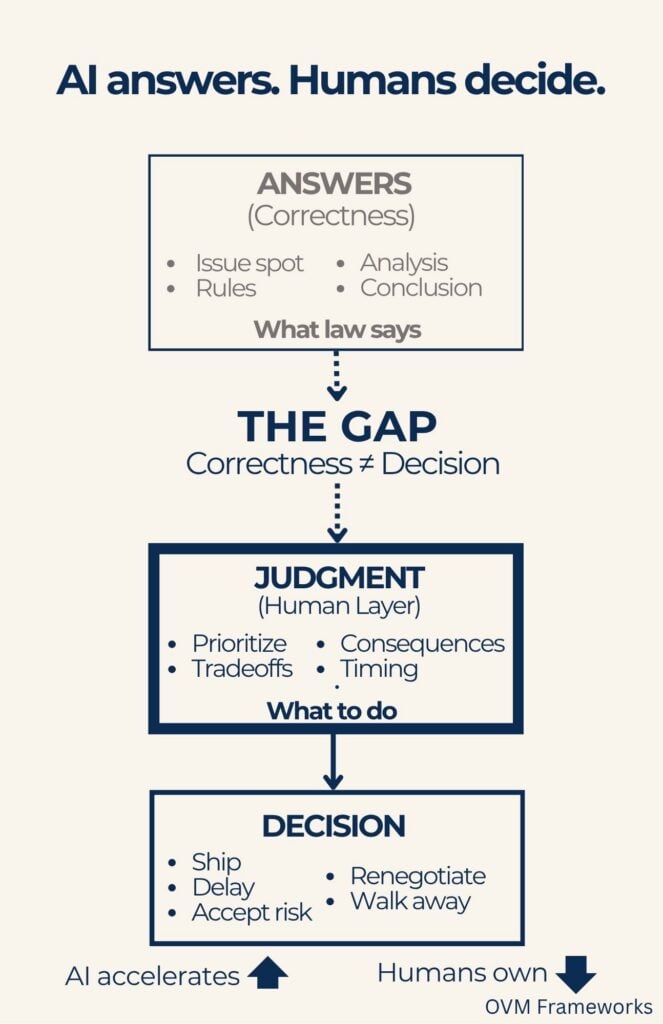
That distinction quietly becomes one of the most important framing shifts in my own thinking about the future of legal work.
Because judgment is not really about memorizing doctrine.
It is about prioritization.
Tradeoffs.
Timing.
Consequences.
Context.
It is about understanding which risks matter most, which risks are acceptable, and what path forward aligns with the broader goals of the business.
Two lawyers can look at the same legal issue and recommend completely different approaches. The difference is often not legal knowledge.
It is judgment.
The Strange Way Lawyers Learn Judgment
What fascinates me is how informally most lawyers develop this skill.
Historically, judgment gets absorbed rather than explicitly taught.
You learn by watching senior lawyers navigate difficult situations. You learn by sitting in tense meetings. You learn by making mistakes. You learn by living through consequences.
Some people develop quickly because they have extraordinary mentors and exposure early in their careers.
Others do not.
A surprising amount depends on environment, access, and luck.
That apprenticeship model works reasonably well when legal knowledge itself is difficult to scale.
But AI changes that equation.
Because many of the tasks junior lawyers historically perform are not only productive work. They are also developmental work. That repetition helps people build instincts slowly over time.
And if professionals outsource too much reasoning too early, there is a real danger that they stop developing judgment altogether.
I already see signs of this.
People accepting outputs too quickly.
People failing to interrogate assumptions.
People stopping at the first plausible answer instead of exploring alternatives.
The risk is not only bad legal outputs.
The deeper risk is intellectual passivity.
The Part About AI That Actually Fascinates Me
At the same time, I think there is another possible outcome here that receives much less attention.
AI could actually help accelerate the development of judgment.
That possibility interests me far more than the endless debate about whether AI replaces lawyers.
Because if used thoughtfully, AI can expose reasoning in ways that are historically difficult to scale.
It can create simulations.
It can surface competing considerations.
It can force prioritization.
It can expose second-order consequences.
It can create comparison loops across scenarios.
Most importantly, it can make invisible reasoning more visible.
That matters because experienced professionals often struggle to explain how they reach a conclusion. After enough years, judgment starts feeling instinctive.
But instinct is usually compressed experience.
Once you start unpacking that experience, patterns emerge.
The same questions appear repeatedly underneath difficult decisions:
What matters most?
What are we optimizing for?
What risk are we actually willing to tolerate?
What happens if we are wrong?
What happens if we wait?
That is where legal judgment actually lives.
Not in abstract doctrine.
In decisions under constraint.
What Businesses Start Valuing More
I increasingly think the lawyers who will thrive over the next decade are not necessarily the fastest researchers or the most efficient drafters.
AI handles more and more of that work.
The lawyers who will stand out are the ones who can navigate ambiguity without freezing. The ones who can balance legal analysis with operational reality. The ones who can translate uncertainty into action.
Because businesses rarely pay lawyers simply to identify problems.
They pay lawyers to help navigate decisions.
And in an AI-enabled world, that distinction becomes much more important.
If you are interested in exploring how legal judgment can be developed more intentionally for product counsel, the Frankie early access list is open.
Olga V. Mack is the CEO of TermScout, where she builds legal systems that make contracts faster to understand, easier to operate, and more trustworthy in real business conditions. Her work focuses on how legal rules allocate power, manage risk, and shape decisions under uncertainty. A serial CEO and former General Counsel, Olga previously led a legal technology company through acquisition by LexisNexis. She teaches at Berkeley Law and is a Fellow at CodeX, the Stanford Center for Legal Informatics. She has authored several books on legal innovation and technology, delivered six TEDx talks, and her insights regularly appear in Forbes, Bloomberg Law, VentureBeat, TechCrunch, and Above the Law. Her work treats law as essential infrastructure, designed for how organizations actually operate.
The post Lawyers Were Trained To Find Answers. Businesses Need Decisions. appeared first on Above the Law.
from Above the Law https://ift.tt/mhzSIfM
via IFTTT