
The president has a tried-and-true business model for media trollsuits: fire off a bumptious shakedown letter, sue for billions in damages, and wait for a nervous corporate defendant with business before the government to hand him a check. It worked with Twitter, Meta, Google, and CBS. But it has never once worked in an actual courtroom.
Last November, after a conservative British newspaper published an internal memo accusing the British Broadcasting Corporation of splicing together two sections of Trump’s January 6 speech to imply that he’d exhorted his supporters to violently attack the Capitol, Trump ran the same play. His current defamation lawyer, Alejandro Brito, fired off a nastygram demanding a retraction, an apology, and “appropriate compensation.”
The BBC duly apologized and retracted the segment. It did not, however, cut him a check — something which would have been a bigger scandal for the taxpayer-funded broadcaster than the original screw-up. Instead it hired Charles Tobin, one of the best media lawyers in America, and spent the past seven months kicking Trump in the bollocks.
Turns out, when you file a $10 billion defamation suit, you have to participate in discovery! Who knew!
Always be trolling
Trump’s complaint, filed in the Southern District of Florida, suffers from a fatal flaw: The offending program never aired in the US, wasn’t available on the American cable channel BritBox, and wouldn’t play on BBC.com from a US IP address. The plaintiffs’ current theories are: 1) Maybe it actually was available in America??? or 2) Floridians’ use of VPNs spiked in January of 2025, and so someone in Florida must have watched it there.
(Sure, Florida’s age-verification law for adult content took effect January 1, 2025. But doesn’t it seem more likely that people were using VPNs to fap to Auntie Beeb than boring, old porn?)
In January, the BBC moved to stay merits discovery until its motion to dismiss for lack of personal jurisdiction was resolved. Judge Roy Altman, who was initially quite solicitous of the guy who appointed him, denied the motion. BBC then did what any competent lawyer could have predicted: First, it subpoenaed every person and entity that was anywhere near Trump in January of 2021 for evidence that he actually did intend for his followers to violently attack the Capitol. Then it demanded Trump hand over his financial records to prove that there was no “massive economic damage to his brand value and significant damage and injury to his future financial prospects.”
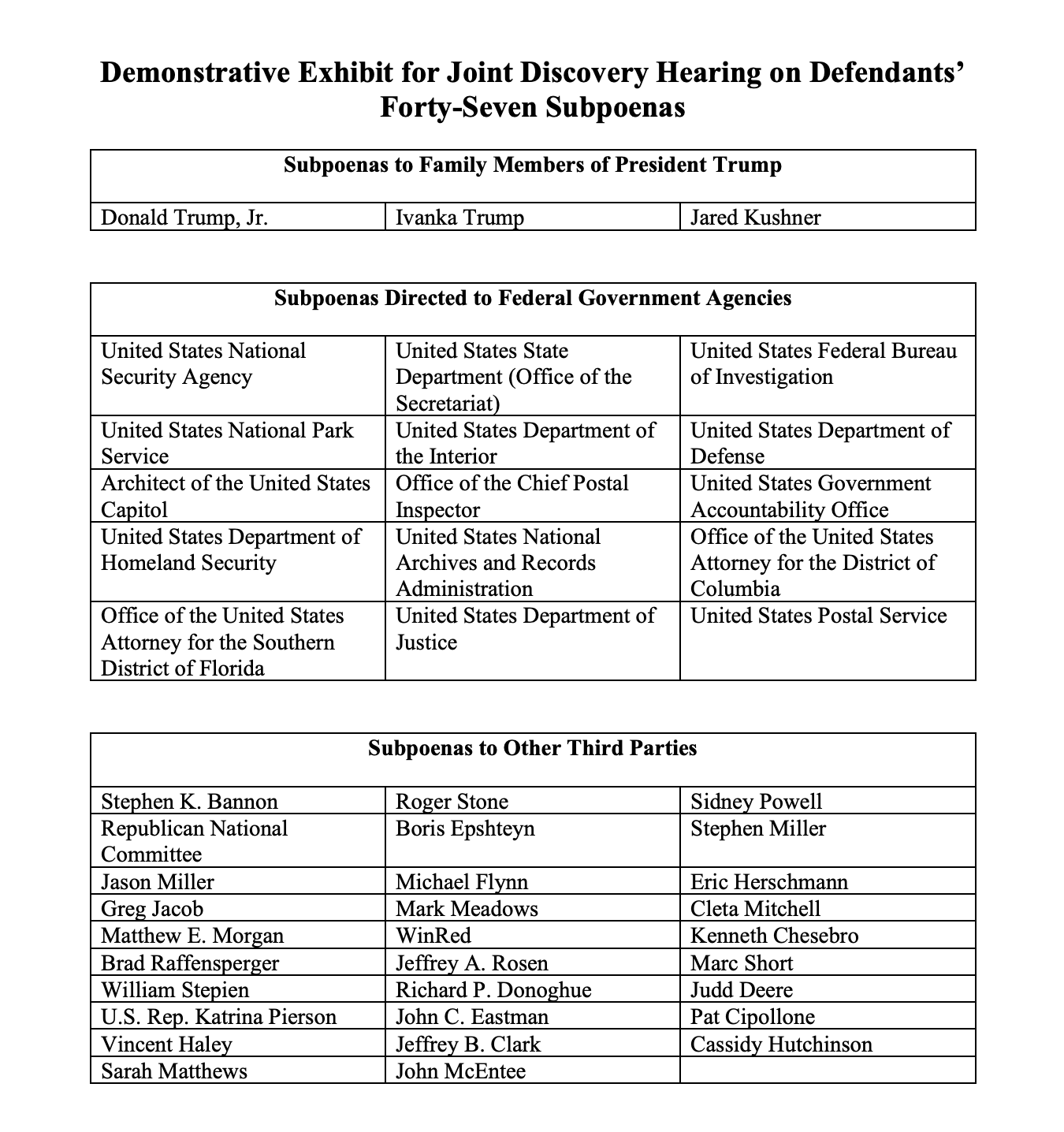
As of a July 6, nearly four months after being served requests and with a protective order in place since April, Trump had produced zero documents to the BBC. In that time, the BBC produced over 5,200 documents spanning roughly 47,500 pages in response to 503 discovery requests. Trump’s counsel promised update dates in May, then June, then blew past both, before finally proposing an initial production for July 20 — one day before the discovery hearing on Tuesday. His Requests for Admission responses gave the same boilerplate objection to 114 of 152 requests, including refusing to admit or deny whether he’d spoken with Rudy Giuliani, Steve Bannon, Roger Stone, or John Eastman in the 24 hours before his speech on the Ellipse.
Along the way, Trump’s team managed to squander its home court advantage. First Brito failed to respond to the BBC’s motion to dismiss, prompting Judge Altman (who uses the royal “we”) to ask “(1) whether we should consider the Motion to Dismiss unopposed and (2) why we shouldn’t sanction the Plaintiff’s counsel for their apparent disregard of court deadlines.” Then Brito refused to confer with opposing counsel, eliciting a furious response from Magistrate Judge Enjoliqué A. Lett:
While counsel are free to disagree with the relief and basis on which the opposing party may seek said relief, they are not permitted to disregard the Court’s orders and procedures.
Brito followed this up with an unsuccessful campaign to get Judge Lett thrown off the case.
At some point, it appears to have occurred to the plaintiff that it was probably a bad idea to pit an eight-lawyer boutique firm against the megafirm Ballard Spahr and a defendant who wasn’t about to roll over and write a check.
Call in the cavalry
On July 14, DOJ filed a “statement of interest” in the case, objecting to the BBC’s subpoenas as overbroad, burdensome, and duplicative of documents already in the public record. Bizarrely, the government objects to subpoenas sent to purely private parties — Sidney Powell, Roger Stone, Donald Trump Jr., the RNC, WinRed — in addition to the twelve federal agencies. As the BBC notes, it’s more than a little ironic for the DOJ to complained about a subpoena for Don Jr. when his Secret Service detail has thus far blocked BBC from serving him at all.
Procedurally, though, the government’s attempt to bigfoot into this case is even weirder. Every federal agency has Touhy regulations (named for the 1951 Supreme Court case United States ex rel. Touhy v. Ragen), dictating how employees should respond to litigation demands. The agencies are, of course, entitled to challenge those subpoenas individually. But they can’t just pile together as a Trojan Horse to insert themselves into a civil suit as a means for the Justice Department to ride to Trump’s rescue.
Meanwhile in Washington, there’s another discovery fight underway with respect to evidence from Special Counsel Jack Smith’s election interference case against Trump.
Back in May, the BBC petitioned Chief Judge James Boasberg in DC to unseal the 2022 rulings in which then-Chief Judge Beryl Howell rejected Trump’s executive privilege claims with respect to fourteen witnesses. The BBC would like to subpoena many of those same “Stop the Steal” goons, and they hope to head off any argument over executive privilege. They reason that, if Trump already lost those same privilege fights in DC, he shouldn’t get to relitigate them anew in Florida.
DOJ’s opposition makes a great fuss about the New York Times’s failed effort to unseal those same records last year.
“Journalists represented by the same counsel as Petitioners here argued for full access to these rulings, yet this Court ruled that the government’s redactions were proper because the redacted information was secret grand jury information protected by Federal Rule of Criminal Procedure 6(e),” they snark, adding that the BBC hasn’t shown the “particularized need” required to unlock grand jury materials.
And perhaps that’s right as a matter of law. But it’s pretty nervy to file a “statement of interest” that never mentions executive privilege, even though Trump’s use of his office to block the subpoenas is clearly going to be the biggest discovery issue in this case. As the BBC pointed out, the DOJ’s supposedly neutral concern about non-party burden conveniently skips the part where the plaintiff himself controls all the non-parties! Trump wants it both ways: privilege as a sword to block discovery in Florida, and the record of him losing that same privilege fight in DC kept out of view.
All of this has more than a faint whiff of déjà vu. In 2020, then-AG Bill Barr swooped in to substitute the government as defendant in E. Jean Carroll’s original defamation suit against Trump. Multiple courts rejected the claim that he was acting within the scope of his presidential duties when he said that Carroll was too unattractive to assault, but the DOJ is still making that case to the Supreme Court.
More recently Trump sued the IRS for the wrongful disclosure of his tax returns in 2020, and then “settled” for immunity for all prior tax crimes plus a $1.8 slush fund for his supporters — despite the fact that the case was categorically barred by the statute of limitations. Judge Kathleen Williams blasted the government for effecting a fraud on the court by pretending that there were two adverse parties, rather than Trump “suing” an agency he controlled as a means of conferring legitimacy on a ploy to loot the treasury and secure a get-out-of-jail-free card for himself. Judge Williams referred Brito to the Florida bar for possible discipline and banned Daniel Epstein, who is also entered on the BBC case, from appearing pro hac in the Southern District of Florida for a year.
You should leave now
At this point, any rational litigant would quietly slink away. This case is jurisdictionally DOA, doomed on the merits, and runs the very real risk of getting the president’s lawyers sanctioned again. And on top of all that, the BBC is making it clear that it will make this incredibly expensive and unpleasant — not just for Trump and his lawyers, but for all of his “Stop the Steal” buddies, too.
Instead, the president is trying to get the Justice Department to ride in and save him like the French fleet showing up outside Yorktown. But Donald Trump is no George Washington, and the DOJ’s not going to save him from British.
Washington won the war. Trump can’t win a discovery hearing.
Liz Dye produces the Law and Chaos Substack and podcast. You can subscribe by clicking the logo:
The post Trump Bit Off More Than He Could Chew Suing BBC, So DOJ Will Chew It For Him appeared first on Above the Law.
from Above the Law https://ift.tt/Pm3gqu0
via IFTTT